
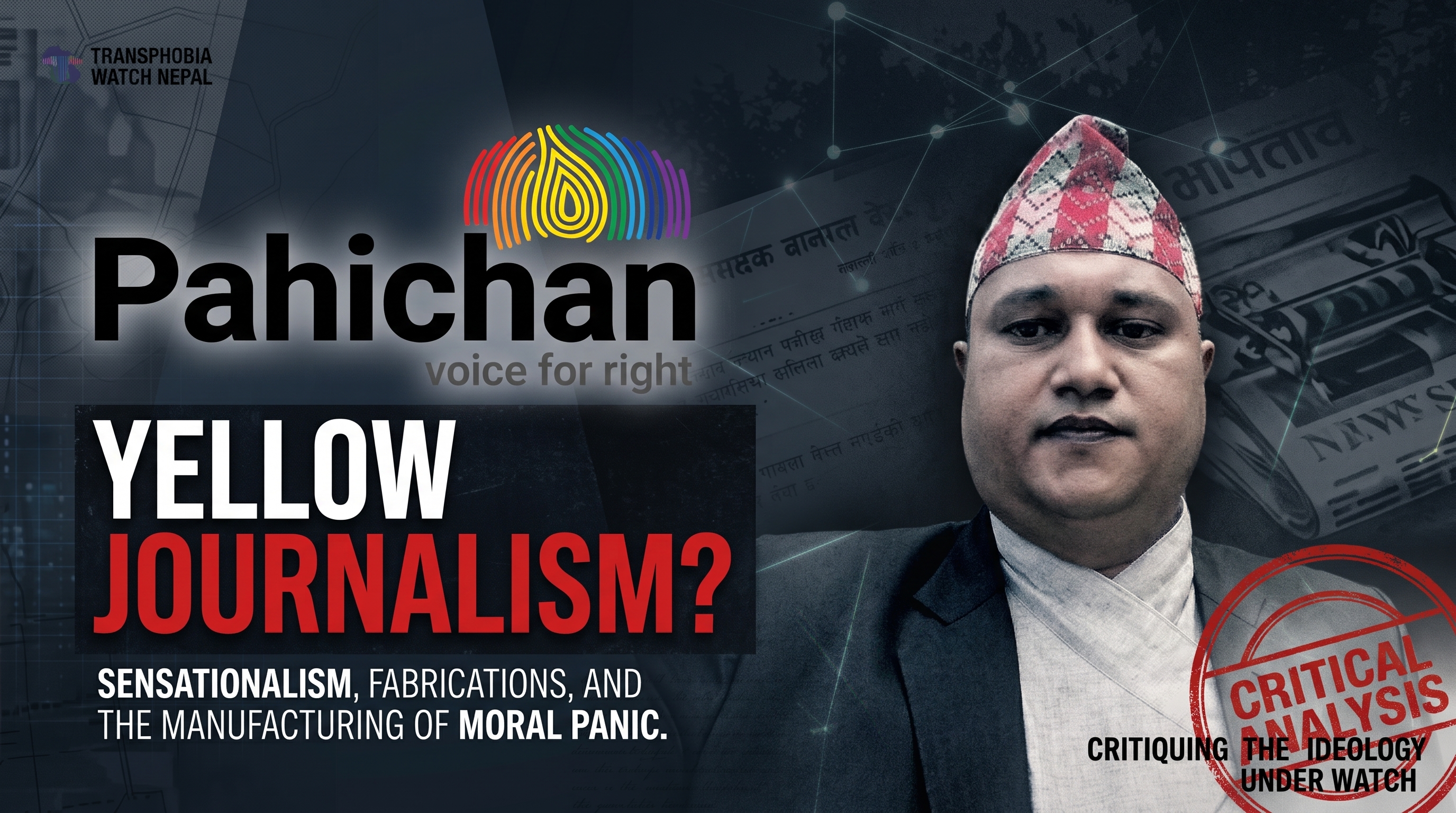
In an era where digital publishing demands heightened accountability, Pahichan Media Pvt. Ltd., operating online via pahichan.com and registered under the Department of Information and Broadcasting as Registration No. 162/073-74, has increasingly abandoned the foundational ethics of responsible reporting.
Led structurally by Executive Director Bhawani Ghimire, Founding Editor Madhav Dulal, Editor Soham Subedi, and Manager Arjun Dulal, the outlet was once positioned to serve public interest and niche representation. In recent years, however, its editorial trajectory has undergone a pronounced shift toward classic yellow journalism. Rather than upholding rigor, fact-checking, and objective nuance, the platform’s output has leaned heavily into sensationalized framing, unsubstantiated claims, and bad-faith coverage designed to stoke controversy rather than inform.
Structured as a multi-part investigative series, this expose examines how an outlet that once branded itself as Nepal’s pioneer LGBTIQ+ media platform has completely dismantled that foundational identity. In its place, the platform has pivoted toward anti-trans sensationalism and systematic hostility. The investigation traces this institutional degeneration, demonstrating how editorial independence was abandoned in favor of entrenched gatekeeping—serially manufacturing praise for a select inner circle while actively vilifying, alienating, and discrediting the rest.
The Leadership Illusion: Who Actually Runs Pahichan Media?
For years, Pahichan Media has built its brand on the backs of queer stories. Yet a cursory examination of its masthead reveals an uncomfortable truth: not a single person at the helm publicly identifies as queer. From its executive management to its editorial board, the outlet is owned and run entirely by cisgender, heterosexual individuals.
This disconnect raises a foundational structural contradiction: Is this truly an authentic, community-led platform amplifying marginalized voices from within, or is it a cisgender, heterosexual-run enterprise patronizing queer lives for clicks, political leverage, and donor proximity? When those who hold editorial authority do not share the lived realities, vulnerabilities, or legal struggles of the community they claim to represent, advocacy frequently degenerates into paternalism—and, ultimately, into exploitation.
The Cult of Personality: Saintly Pioneers and Corrupt Enemies
To read Pahichan Media is to step into a curated melodrama where the heroes and villains have already been cast in advance. The editorial line does not follow evidence; it follows loyalty. The platform does not operate with journalistic detachment; it functions as a public relations megaphone for a narrow circle while weaponizing bad-faith accusations against everyone outside of it.
On one side sits an untouchable pedestal reserved almost exclusively for Sunil Babu Pant and Mayako Pahichan Nepal. They are portrayed through an uncritical lens of saviorism: visionary, selfless, and indispensable. Their press releases are published as gospel, their critiques treated as authoritative decrees, and their public standing rigorously shielded from any standard of media scrutiny.
For this chosen faction, Pahichan Media’s coverage suspends all journalistic skepticism. Pant is framed not merely as an activist, but as an infallible pioneer whose every theoretical detour—from historical revisionism to ideological imports of Cold War subversion rhetoric—is treated as profound scholarship. Coverage of his initiatives reads like institutional press releases: flattering, unchallenged, and celebratory.
On the other side sits virtually the entire remainder of Nepal’s queer and trans movement. Where the favored few receive hagiography, others receive hit pieces. Rival groups, trans advocates, and critical voices are painted with broad, conspiratorial strokes: cast as greedy NGO operatives, predatory figures, or puppets dancing to the tune of foreign dollars. Every internal disagreement is escalated into a public scandal; every grassroots failure is sensationalized to prove institutional corruption.
For other community leaders, emerging youth activists, and independent queer and trans rights organizations, Pahichan Media adopts an aggressively inquisitorial posture rooted in tabloid tropes.
The “Corrupt NGO / Foreign Agent” Trope
While Mayako Pahichan’s affiliations and resources are presented as benign and heroic, other organizations are routinely framed as self-serving recipients of foreign donor money, accused without judicial proof of running exploitative “projects” at the cost of community welfare.
Weaponized Precarity
Genuine medical crises or community disputes are not reported with investigative care; they are instrumentalized to settle movement rivalries. Vulnerable trans individuals (such as in the repeated framing of the “Hema” medical case) are spotlighted not to secure systemic healthcare reform, but to indict specific rival organizations and individuals as negligent or corrupt.
Character Slander vs. Hero Worship
While its favored figures receive glowing headlines and uninterrupted podiums, other activists face sensationalist delegitimization—tarred with pejorative slurs (e.g., The terror of Sugar Monny), accusations of coercion, or insinuations of financial malfeasance.
This creates a closed narrative economy. Pahichan Media establishes a false moral hierarchy: one visionary patriarch and his vehicle vs. a compromised, corrupt, and morally bankrupt grassroots. This is not accountability reporting; it is partisan policing. By holding everyone else to an impossible standard of moral purity while extending total immunity to its preferred patronage network, Pahichan Media betrays the very premise of an independent watchdog. It has transformed a community media project into a factional attack dog.
The Hypocrisy of “Foreign Aid” Alarmism
When Pahichan Media wants to discredit a trans initiative or an independent grassroots leader, its favorite weapon is the specter of the “foreign donor.” Stories are manufactured to sound as if any organization receiving international support is selling out Nepal’s sovereignty and experimenting on vulnerable citizens for Western grants.
The irony is almost absurd. Nepal’s entire civil society—not to mention its government ministries and public infrastructure—relies fundamentally or heavily on international aid. More damningly, Mayako Pahichan Nepal and its leadership regularly and publicly boast of their own partnerships with the European Union and Western embassies.
When Mayako Pahichan courts EU funds and platforms European diplomats, Pahichan Media celebrates it as groundbreaking leadership. But the moment another organization accesses international resources to support community health or legal rights, Pahichan’s headlines turn hysterical, shouting about foreign-funded conspiracies. This is not media ethics; it is pure factional gatekeeping disguised as anti-imperialist virtue signaling.
While Pahichan Media acts as an aggressive auditor toward rival organizations—interrogating their funding sources, organizational intent, and programmatic choices—it maintains total silence regarding its patron organization, Mayako Pahichan Nepal.
A recurring theme in Pahichan Media’s reporting against other organizations—most notably the Blue Diamond Society (BDS) and allied trans initiatives—is the insinuation that their operations exist outside normal state scrutiny. When reporting on rival projects, health interventions, or donor partnerships, the outlet frequently frames formal state clearances not as standard bureaucratic procedure, but as evidence of a clandestine conspiracy. The narrative repeatedly suggests that ministries, the Social Welfare Council (SWC), and district administration offices “magically” rubber-stamp and protect these organizations through shadowy backroom deals, foreign donor coercion, or illicit bureaucratic collusion.
This framing serves an essential propagandistic purpose: it dismisses legitimate, audited institutional compliance as institutional corruption. By insisting that rival groups operate through mysterious state complicity, Pahichan Media attempts to cast doubt on decades of documented statutory approvals, SWC project clearances, tax clearances, and government partnerships.
When Queer Liberation Becomes Anti-Trans Reaction
For an outlet that claims to defend marginalized sexualities and genders, Pahichan Media displays a relentless animosity toward transgender people. In Pahichan’s editorial universe, virtually every aspect of trans identity—whether medical, legal, or social—is framed as a problem to be interrogated, mocked, or exposed.
Bodily transitions are treated not as healthcare or personal autonomy, but as horrific spectacles. Headlines reduce delicate medical journeys to vulgar punchlines about severed or dangling anatomy, designed solely to trigger disgust and curiosity among conservative readers. Whenever a trans individual faces medical complications or post-operative precarity, Pahichan does not call for better state healthcare infrastructure or inclusive health insurance; it exploits their trauma to attack rival organizations and discredit gender-affirming care altogether.
The platform has effectively become a localized clearinghouse for global anti-trans talking points. It runs pieces questioning trans women’s participation in society, applauding foreign bans on trans rights, and warning against a manufactured “trans agenda.” When a supposedly niche community media house spends its ink delegitimizing trans lives, mocking bodily choices, and depicting trans women as predatory menaces, it isn’t practicing journalism—it is actively participating in the marginalization of its ‘own’ community.
Exploiting the Dead: The Christina Magar Case and Breach of Privacy
Nowhere has Pahichan Media’s editorial depravity been clearer than in its exploitation of vulnerable community members in death. When Christina Magar, a 31-year-old trans woman, passed away in September 2024 due to an intracranial vascular rupture at Chirayu Hospital, Pahichan Media bypassed basic journalistic dignity to spin a sensationalist narrative. Without medical corroboration, the outlet sensationalized her tragic death as an immediate consequence of “hormone medications” (“Christina’s death sparks concern about hormone therapy in Nepal”).
The reporting did not stop at unverified medical causality. To heighten tabloid curiosity, the outlet published non-consensual details concerning her alleged survival sex work, stripping away her right to privacy and defaming her memory. This triggered an official joint complaint filed with the Press Council Nepal by multiple sexual and gender minority organizations—including the Blue Diamond Society (BDS), the Federation of Sexual and Gender Minorities Nepal, and Cruiseaids.
Rather than engaging in ethical reflection or offering a retraction, Pahichan Media weaponized the complaint itself. It ran follow-up coverage framing the backlash as an orchestrated conspiracy by BDS to muzzle independent media and force mandatory medical interventions on community members. By treating a deceased woman’s medical history and private life as sensational tabloid material, Pahichan proved that no personal tragedy is too sacred to be exploited in service of its factional agenda.
The “Good Queer” vs. “Bad Trans” Wedge: Co-opting Marriage While Demonizing Healthcare
A deeper reading of Pahichan Media’s recent trajectory reveals a calculated narrative wedge: elevating marriage equality while pathologizing gender-affirming care.
When covering the interim orders and local-level registration of same-sex partnerships achieved by Maya Gurung and Surendra Pandey through Mayako Pahichan Nepal, the outlet’s coverage was effusive. It portrayed the milestone not merely as a legal victory, but as an exclusive triumph achieved solely through their chosen leaders, deliberately writing out decades of preceding constitutional jurisprudence, PIL filings, and coalition advocacy by the broader movement.
However, when it comes to transgender health rights, the outlet adopts reactionary hostility. It has published headlines explicitly attacking healthcare initiatives under the banner of marriage advocacy (e.g., Clinics distributing hormones under the cover of marital rights). This creates an artificial division.
The “Respectable” Queer Struggle: Civil union and marriage advocacy led by the favored few, framed as dignified, patriotic, and culturally grounded.
The “Corrupting” Trans Medical Struggle: Gender-affirming hormone therapy (GAHT) and gender-affirming surgeries (GAS), framed as covert, unregulated foreign-funded experiments corrupting Nepali youth.
By pitting legal relationship recognition directly against bodily autonomy, Pahichan Media isolates trans individuals from the broader LGBTIQ+ coalition, manufacturing the exact same “LGB-without-the-T” wedge currently weaponized by far-right interest groups globally.
Alarming silence of regulatory bodies
A critical question emerges from Pahichan Media’s sustained ethical drift: how has a legally accredited digital platform managed to weaponize defamation, violate individual privacy, and run targeted anti-trans disinformation campaigns with near-total impunity from state authorities?
In Nepal, digital publishing and non-profit operations are governed by a complex web of statutory regulators, primarily the Press Council, the Department of Information and Broadcasting, the Social Welfare Council, and district administration offices. These public bodies possess broad legal authority to monitor media ethics, investigate compliance, audit foreign-funded project activities, and penalize violations of civil rights. Yet, when confronted with Pahichan Media and its allied patron network, this regulatory machinery has lapsed into profound administrative paralysis.
Under the enforceable national journalistic code of conduct, the Press Council is legally mandated to curb sensationalism, safeguard human dignity, and penalize outlets that broadcast indecent, vulgar, or defamatory material. Despite formal complaints—most notably the joint petitions filed by rights organizations following the outlet’s exploitative coverage of a deceased trans woman’s private life and medical history—the statutory response has remained conspicuously passive. The Council has failed to issue binding directives, mandate public retractions, or apply concrete sanctions against the platform’s persistent use of vulgar anatomical headlines, single-sourced hit pieces, and unverified medical falsehoods regarding hormone therapies. This failure of proactive enforcement has effectively transformed the state’s ethical watchdog into a toothless observer, leaving marginalized individuals with zero institutional protection against digital harassment.
This regulatory inertia is equally glaring within the non-profit sector that underpins the outlet’s ideological circle. By law, non-governmental entities that receive international assistance are strictly required to secure prior project approvals, undergo mid-term evaluations, conduct mandatory public social audits, and disclose itemized expenditures of all foreign embassy and multilateral grants. Grassroots trans collectives routinely face suffocating bureaucratic scrutiny, prolonged vetting, and administrative delays for basic compliance. In stark contrast, the patron organizations celebrated by Pahichan Media operate within an opaque black box. Despite publicly flaunting European Union partnerships and foreign embassy funding, they escape public community audits and granular financial disclosures, all while regulatory desks look the other way.
Ultimately, the trajectory of Pahichan Media serves as a cautionary tale of how a platform once envisioned to champion marginalized voices can be co-opted, hollowed out, and converted into an instrument of harm. By abandoning rigorous journalism in favor of click-driven sensationalism, weaponizing anti-trans tropes, and trading authentic community advocacy for the uncritical veneration of a select few, the outlet has forfeited its moral and professional authority. Media freedom is not a license for unchecked character assassination, nor is representation a commodity to be exploited by cisgender gatekeepers insulated from the very struggles they broadcast. Until regulatory bodies enforce genuine accountability and the platform is confronted with its own structural hypocrisy, Pahichan Media will remain not a voice for rights, but a textbook monument to the dangers of yellow journalism operating under the stolen banner of liberation.
Our ongoing investigation will continue to document Pahichan Media’s financial ties, patronage networks, and ethical violations in upcoming installments. By confronting its sensationalist hit pieces with verified facts and community testimonies, this series remains committed to dismantling the outlet’s culture of impunity.
#PahichanUnmasked #YellowPahichan
Click to view referenced Pahichan Media articles & links ▼
1. Sensationalism & Bodily Framing
- ‘झुन्डिएको लिङ्ग’ कि ‘काटेको लिङ्ग’?
- विदेशी दातृ निकायको सहयोगमा शिक्षण अस्पतालमा सेक्सचेन्ज गराइएकी हेमाको बिचल्ली
2. Christina Magar Case (Privacy & Ethics Complaints)
- Third gender individual’s death sparks concern over hormone therapy in Nepal
- Complaint filed against Pahichan media over report on third gender woman’s death
3. Tabloid Slander & Movement Gatekeeping
- तेस्रोलिंगी ‘सुगर ममी’को आतङ्क, संस्थागत संरक्षणको आशङ्का
- सर्वोच्चको मुद्दा फिर्ता लिन मनिषाको दबाब, प्रोजेक्ट रोक्ने धम्की
Leave a Reply